
Development
Artificial Intelligence
AWS
Artificial Intelligence
Claude
Dual-window AI coach chatbot for Amazon leaders
The Accelerate App is a digital companion to an in-person leadership development program at Amazon, designed to sustain learning beyond the classroom through AI-powered personalized experiences.
Problem:
- In-person training does not produce consistent retention of behavioral skills
- No safe place to practice difficult conversations (feedback, conflict and so on)
- Existing solutions are passive (reading, video) and don't build real skill
- Scaling one-on-one coaching to thousands of leaders is not feasible
Solution:
- We built a practice chatbot with two simultaneous conversation windows
- One AI simulates the person in the conversation (the persona), while another acts as a coach in real time
- The user practices, gets immediate feedback and can adjust their approach during the interaction
- The system is tied to the user's individual development plan and competencies
Technologies used:
- Amazon Bedrock (Claude)
- AWS Lambda
- DynamoDB
- Custom web front end
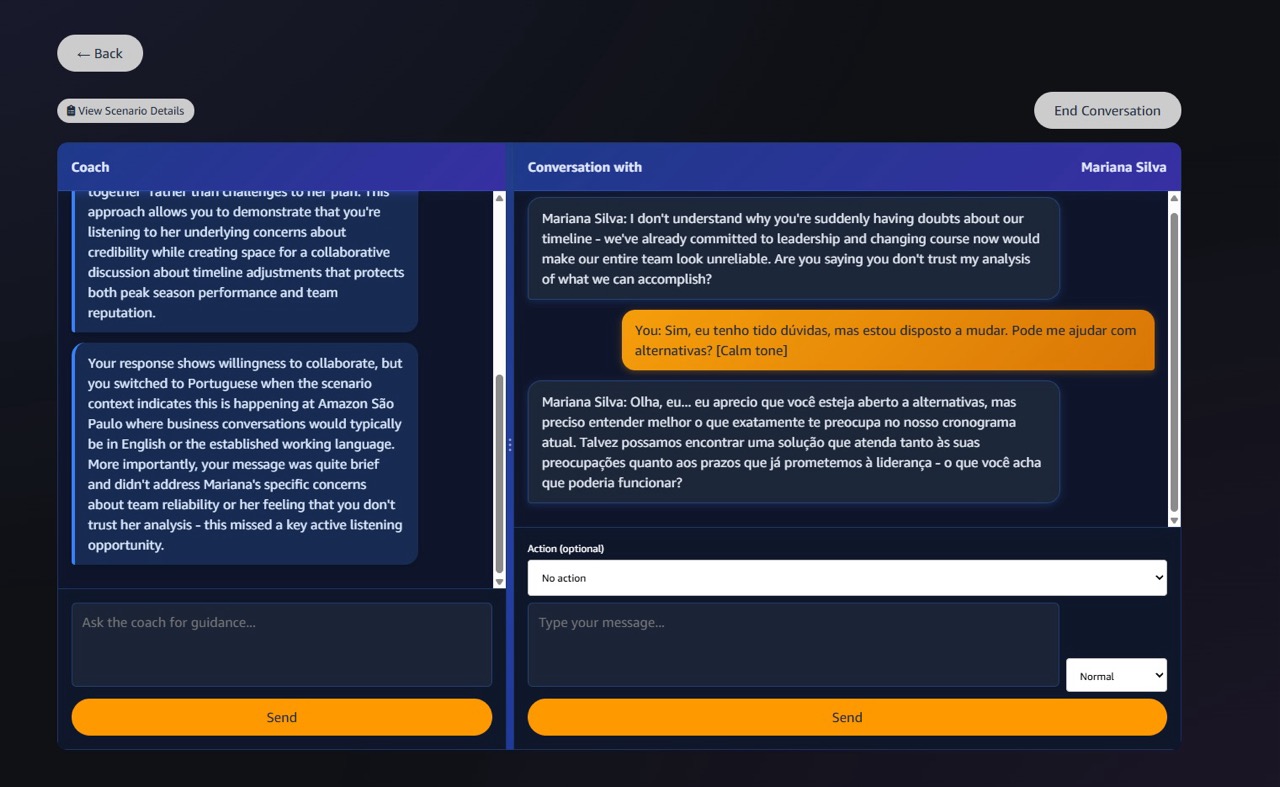
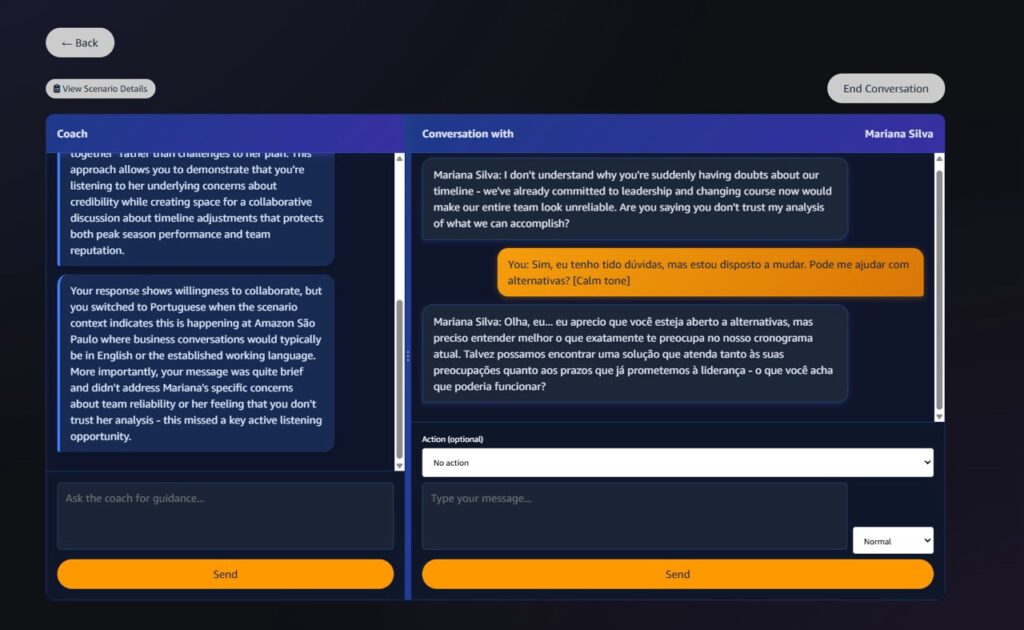 Chatbot window. The coach is on the left and the conversation on the right.
Moving past the generic chatbot nobody can stand anymore.
The solution was designed to solve a structural problem: teaching leadership is not enough, you need to create practice loops with immediate feedback. I modeled the experience as two parallel systems running at the same time:
- A simulation system (the persona)
- A metacognition system (the coach) Unlike traditional chatbots, where you talk and the AI role-plays a persona, in this app you pick the leadership situation you want to put yourself in, and another persona helps you from the side. This separation allows something rare: the user acts inside the conversation while simultaneously receiving guidance outside it. In addition:
- The user's context (role, gaps, goals) dynamically feeds the AI's responses
- The system keeps a complete history for later evaluation
- The architecture scales coaching without depending on human facilitators
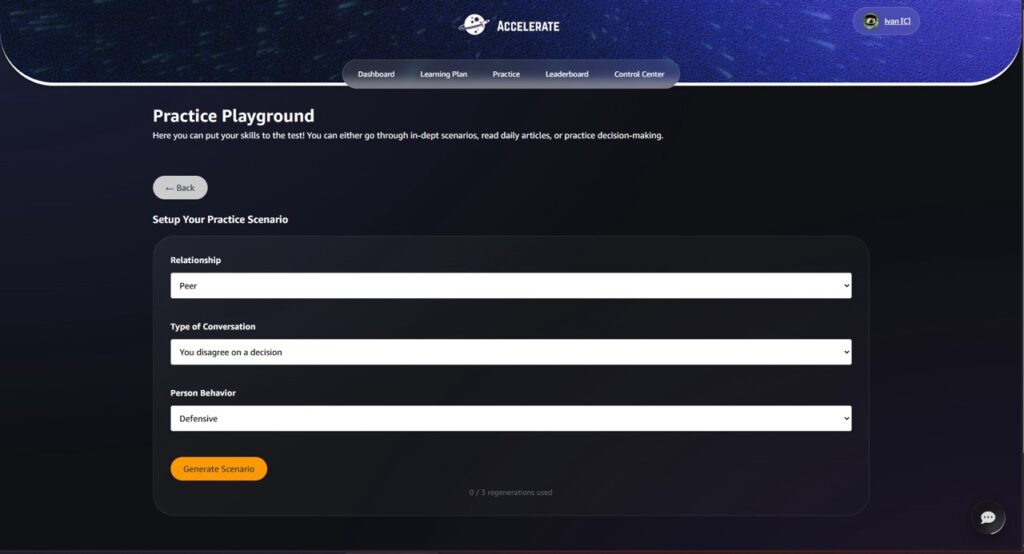 On this screen, you set the parameters for scenario generation.
Development journey and experience
The main design decision was to avoid a linear chatbot. Instead, I built an interface with two windows:
- Right: the main conversation (immersion)
- Left: the coach (reflection) This solves a common problem: when feedback only comes afterward, learning is slower. With real-time feedback:
- Users test hypotheses immediately
- They adjust tone, approach and the structure of what they say
- They build behavioral awareness while acting I also introduced:
- Suggestions for action and tone (for example, empathetic or direct)
- Socratic feedback (no ready-made answers)
- Automatic end of the conversation, with an evaluation
Features
The system evolved to include:
- Dynamic scenario generation based on the user's profile
- Personas with realistic behaviors (defensive, emotional and so on)
- Real-time feedback aligned to leadership competencies
- A parallel chat with the coach for on-demand guidance
- Automatic evaluation of the conversation, with a score
- A points system and leaderboard integration During development, the main improvement was moving from a generic chatbot to a highly contextual, competency-driven system.
Results
- Theoretical content turned into active practice
- Individual coaching at scale, without proportional cost
- Higher engagement through simulation and gamification
- Faster development of critical leadership skills Lessons learned:
- Real-time feedback completely changes the learning curve
- Separating simulation from coaching improves cognitive clarity
- Personalization is essential for relevance Next steps:
- Evolve the evaluation into longitudinal analysis of behavior
- Connect performance in the app with real performance at work
This project is the kind of solution I build today at EduBuilders, combining a pedagogical foundation with software.