

What is the product adoption curve and how to improve it
One of the biggest problems startups face is improving product adoption and getting users to learn how to use the features, from the simplest to the most advanced. If you're here, you've noticed (probably from the title of this article, ha) that your users aren't sticking around on your platform, even though your marketing attracts plenty of people.
For that, it will be crucial to know what the product adoption curve is and how to create strategies to improve user retention.
As simple as it may seem, some companies skip basic steps and jump straight to the end, expecting great results. That's not quite how it works...
In this guide, we've prepared complete content so that by the time you finish reading, you'll know what the product adoption curve is and the step-by-step process to help your customers see more value and use your product more. We'll help you understand everything from the basics of what product adoption is and why it matters, to tips on understanding your product's users, and we'll detail the processes you can improve at the beginning, middle and end of the journey.
With all this information ready to use in your startup, you'll feel more comfortable and confident creating an action plan to improve user retention.
WHAT IS PRODUCT ADOPTION AND WHY DOES IT MATTER?
First, let's understand what the product adoption curve is. There's no point in wanting to change a process in your startup if you haven't understood the end goal.
In short, the product adoption curve refers to how many of your product's features your users actually use. In other words, whether your product is being well accepted, or adopted, by customers who become frequent users. The basic premise is that the more people use your product, the harder it is for them to give it up or even switch to a competitor.
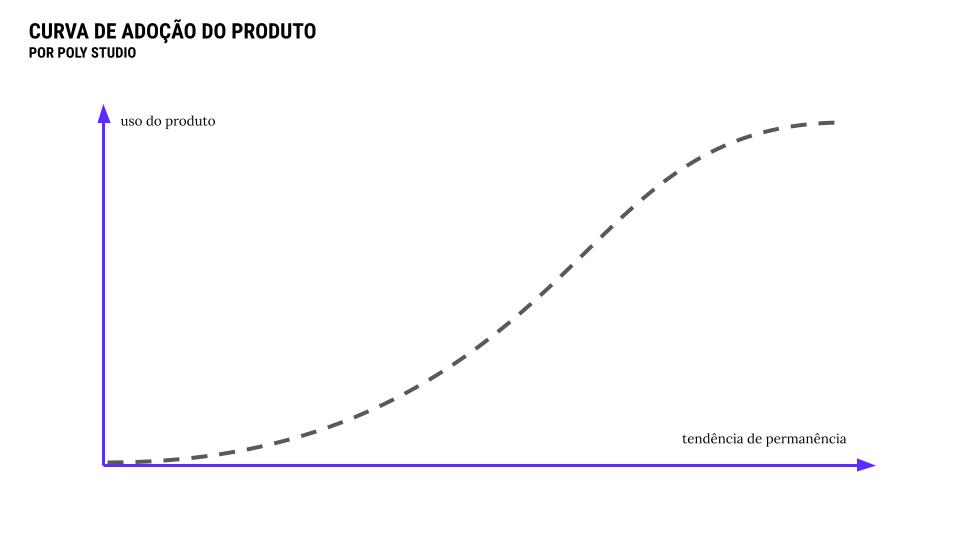
Take a tool like Google Drive. You already have many personal documents there, and some people have used it since its launch in 2012. So it becomes very unlikely that you'd switch to a competitor without a good reason.
And why is it a curve? Because users don't start using all the features at once. They "adopt" new features as time goes by and realize they need them. It's no coincidence that many of these products have online tours that teach how to use the simplest features, so users see value quickly and start using it right away.
For example, the most basic feature of Excel isn't VBA or the VLOOKUP formula. That comes later. It's learning how to fill in a cell, how to add things up or how to style your table. Those are the essential features.
 Image taken from Miro's Medium
MEETING THE NEW PRODUCT ADOPTION CURVE
When people think about the product adoption curve, many also talk about the new product adoption curve, or diffusion of innovation. This curve represents the 5 user profiles that will start using a new product on the market, and how you can or should direct marketing efforts at each type of user depending on the stage your product is in.
That's because, according to this theory, there are 5 types of profiles when it comes to consuming something new on the market. Each of these profiles has its own way of dealing with new products, ranging from eager consumers to wary people. This matters for your business because knowing the type of consumer and how they behave toward new things will lead you to think of different marketing techniques to attract them.
As we explain the gradual adoption of your product's features, we'll constantly refer to the innovation curve, since each user behaves differently.
WHY STUDY THE PRODUCT ADOPTION CURVE?
By now you probably want to know the second item of the topic: "why does product adoption matter?" Well, your startup could make a product, sell it and leave it at that. The customer buys it and, hopefully, is satisfied, but doesn't come back to your page to buy again or has no incentive to recommend it to others. In that scenario, the goal of selling the product was in fact achieved, but all the other benefits that could have come from this exchange were ignored. And benefits not only for your startup, but also for the customer.
Successful gradual product adoption makes customers not only loyal to your brand, which increases the retention rate, but is also a way to increase revenue, because you'll know where and when sales will happen.
Also, with greater product adoption, your users will start to notice new ways of using it and can also give better feedback to improve those new features. All of this while they consume the new things your startup will be offering.
Sounds amazing, right? But there's no magic, there's effort. To increase your startup's product adoption curve, we've put together 6 homework tasks you need to carry out.
1) UNDERSTAND YOUR USER AND THEIR DIFFICULTIES VERY WELL
Knowing who consumes your products is the basic step to success in any business. If that's already true for selling cake jars, imagine for a startup, which has the barrier of technology use. Understanding your target audience is basic so you can think about customer education strategies.
Using the diffusion of innovation curve, the first user profile is the innovator. These are the people who not only consume innovations before everyone else but also spread the word. And that leads to the second group, the early adopters. They are the ones who will shape the general public's opinion. Between this second group and the third there is a point called the chasm, which divides the people who embrace innovation (groups 1 and 2) from those who are resistant (groups 3, 4 and 5).
That's why it's important for your marketing or product team to pay close attention to which moment your startup is in and which users are using your product, since each audience has a different pace. Group 3 is where you find the early majority, who will consume your products if group 2 has presented the benefits of the innovation well.
The next and last profiles are the late majority, who only adopt if the product already has a name in the market, and finally the laggards, who are wary of change and may not even buy the products.
A STARTUP MARKETER NEEDS TO LEARN ABOUT THE ADOPTION CURVE
As you may have noticed, each of these profiles has its own way of consuming and a specific moment for it. Understanding which of these profiles best fits your audience right now, and thinking about strategies to win over the other groups too, is essential to "push" your customers along the product adoption curve.
Also, mapping potential consumers and the difficulties they have with your product may be what gives you a great idea to improve the product or the customer experience. Understanding the demands and pain points of the people you'll help with your products is the first step to creating something indispensable in their lives.
2) IMPROVE YOUR PRODUCT'S USABILITY
The second point for speeding up your products' adoption rate is improving product usability. Your startup may have the best product ever, one that will solve all problems, but if your customer doesn't know how to use it, your product will be completely disregarded in the market. This is where not only the importance of customer education comes in, but also a moment of attention to the design and how the product was conceived.
Customer feedback is essential at this point, because they didn't take part in the creation process and are using the product. The difficulties they encounter may be simple to solve for those who are familiar with it, but that's not the case for people buying for the first time. This difficulty using products can be decisive in whether they buy again. And also for comments and recommendations on social networks.
With that in mind, besides improving product usability, also invest in support that can help people with any questions they have. At the beginning, without a good support community, that investment is necessary.
3) IMPROVE YOUR CUSTOMER EXPERIENCE
Another way to improve the adoption of your products is to invest in an unforgettable customer experience. Knowing your customers and improving your product's usability make your user have a very good experience using your products, which is a differentiator for whether they buy again.
Empower your team to give the best possible service, make that service easily available, humanized and able to solve each consumer's individual pain. Another way is to provide clear instructions and tips on how to use the product, send the link to the support community and have a platform tutorial. This matters because it makes the initial experience good and increases the chance of building loyalty.
4) WORK WITH EFFECTIVE ONBOARDING
Onboarding is the process of "boarding" your customer onto your product, which can last minutes, hours, days and even weeks, depending on complexity. Onboarding, a very common term in startups, can be done through tutorials, videos, courses or even a 1:1 consulting session with a specialist from your team.
Having effective onboarding will help your customers understand the value of your product. That's because many people abandon products when they don't know how to use them; once again, note the importance of customer education.
Having effective onboarding lets your startup assess where customers are struggling so you can solve it. You need to think of an onboarding that makes sense for your company and can point out those difficulties.
5) CREATE EDUCATIONAL CONTENT
This step is indispensable. You may have noticed that in all the other items a common point was the importance of customer education. That's because it is, without a doubt, something a product shouldn't be without: teaching your consumers how they can get the most from what they're buying.
Your startup needs to create educational content to increase product adoption, because knowing how to use a product is the first step to staying loyal to it. Knowing the features and understanding how to take advantage of these tools will make users feel more at ease and able to explore. They may even discover needs that weren't obvious to them.
6) HAVE A SUPPORT COMMUNITY
Nothing is better for increasing your product's adoption than having an engaged support community! This is a process we recommend when a user community already exists and your company's team is also needed to manage it.
Without a doubt, the best advertising you can have for your products is consumers who defend your brand and help new users get the most out of your product.
These communities are made up of people who trust your startup and always want the best from your products. They will be the customers who give feedback on many points of improvement and also think of different ways to use your products that you may never have even considered.
These communities, if truly engaged, are also a way to reduce customer service costs, since the most basic questions can be answered by the longer-standing consumers themselves.
WORKING ON THE PRODUCT ADOPTION CURVE WILL SAVE YOU A LOT DOWN THE ROAD
Here are the 6 basic concepts behind each strategy so you can understand what the product adoption curve is and increase it. They aren't the only ones. In fact, we at Poly constantly tell our clients that there is no silver bullet, but rather a combined strategy of factors that will help your startup's customers and users see more and more value. All of this will depend on your product, its nature, and who your customer is, their profile.
You should also pay attention to product adoption metrics, but that's for another piece of content. There's not much point in executing, executing, executing without knowing whether what you're doing is working, right?