How to become an online teacher
An online instructor is a teacher who teaches over the internet. Pretty obvious, right? We like to use the term "instructor" because we focus much more on the technical side and on teaching a specific skill, so as not to confuse it with the social role that the word "teacher" connotes.
This "side" profession has gotten a lot of attention in recent years with the so-called gig economy. Many articles highlighted that you could teach people with recorded content and earn extra income from it. That was especially true in 2020, with an increase of more than 400% in new sign-ups and 55% in new course creation on Udemy alone, according to a report from the platform itself.
That's why I created Escola de Polímatas, a place to help professionals become education influencers.
What is an online instructor?
An online instructor (or teacher) performs a good part of the tasks of a conventional teacher in terms of teaching. The difference is, of course, the medium, the learner's goal and the bond with your audience.
There are instructors for every audience: children, young people, adults and seniors. Of course, the tools used, the media provided and the entire process can be different. You can be an online instructor exclusively, in the sense of creating your content and stopping there. You can become a tutor, giving instructions to learners on previously created content. Or you can also be an education influencer, creating content on a recurring basis for your followers, like YouTubers and Instagram influencers, for example.
If you're going to work in the corporate market, you'll have to develop specific vendor skills, sticking to your client's requirements.
Some of the responsibilities of an online instructor include:
- Defining the target audience and needs
- Writing the content objectives
- Organizing the course and its units
- Selecting media and supplementary materials
- Designing activities
- Leading the instruction
- Preparing assignments to check learning
- Following the delivery and providing feedback
- Revising the materials
If you also want to act as an education influencer, you'll have to create new materials and interact with your followers in a much less formal way than an instructor, but probably much more often.
Of course, this is a brief, generalized description. We can add or remove activities depending on what you intend and are willing to do.
Expected earnings
Before we start, it's important to be clear about what income you can expect. As you can imagine, it varies a lot with the field, the quality of the course, the number of enrollments and, of course, quality. While a large number of courses don't average more than R$500 a month (Brazilian reais), a few earn above R$3,000 or R$5,000 a month.
That's why it's important to manage your expectations. Not to mention that those with higher earnings probably end up investing more in marketing. There are platforms that do the promotion for you but take a bigger share of the revenue (up to 75%), and others that charge 5% per sale (not counting card and payment slip fees) but leave you fully responsible for promotion.
So before deciding which platform to pick, which is often a very frequent initial question from our clients, you first have to think about your time availability and how you want to position yourself.
A quick example: for a while, I sold my courses at a higher price but offered more support to learners and handled all the promotion myself. I spent R$1,000 to R$3,000 a month in the early months. Until I decided to give up a bit of the revenue percentage to spend less time on marketing. In the end, my income increased a lot in that respect.
Skills needed
Online instructors and education influencers have to juggle and balance many plates at once. Note that before you become a well-known education influencer, you'll have to be a learner. You'll certainly come across new techniques and knowledge to improve your positioning. That is a golden opportunity to run a benchmark study of techniques and good things other teachers are doing, and of the features of the platforms you'll want to use.
Here are five essential skills (to start) that online teachers should have.
Expertise: what do you bring to the table?
The basics: if you want to teach something, you have to master the field. And a very interesting side is that, as you build your lesson, you'll probably notice new points you don't master as well and new developments in the field (if you do your research). We once had a client who came to us and said, "I know this field very well, but I'd like your help to cover other points of view." He hired our services to help him fatten up his references.
You don't need to be the world's number one expert in the field. That will certainly help, but there can only be one number one, right? What has caught my attention with my clients and colleagues is that offering a unique take on a subject, when well grounded, gets more traction than more of the same.
You can be an excellent salesperson, but if you only talk about the SPIN selling method, you'll probably be one more in the crowd. What do you have to contribute? SPIN selling applied to the medical field? SPIN selling at trade fairs and showrooms? What is your unique view on the subject?
Audience: do you know your future learners?
With the subject on the tip of your tongue, the next step is to define your audience better. If you want to build content, you need to understand what this audience is looking for and what they should have mastered after taking your course. It helps a lot if you've already worked with this audience and understand their motivations.
If you have experience selling to this audience, whether products or services, that's a plus. If it's a new audience you only have some distant experience with, my biggest invitation is to do a good benchmark and audience study. That way you don't waste as much time redoing your content after feedback.
Teaching skill: how you teach
It's not enough to master the subject; you have to know how to convey it. Teaching skill, broadly speaking, is concerned with the learner's current knowledge and how to bring them to the desired level or state. That's why a teacher with a teaching method can lead the learner through a sequence of steps they can absorb satisfactorily.
While in in-person teaching you can make many adaptations, in online teaching you face the barrier that you'll probably have to increase the number of lessons to cover as many sequences as possible, or be very, very clear about who your target audience is, in order to narrow the number of participating learners a bit.
Finally, it's important to stress that the concept of a good teacher varies from learner to learner, given that it isn't a clearly established concept. However many teaching steps a teacher has followed, their delivery or communication style may not please a certain audience. That's why I included charisma as the next step. This ends up being very relevant, especially for education influencers.
Charisma: charming your audience
From the title, you can deduce that most of an online teacher's communication happens through screens. I didn't believe there was so much difference between teaching in person and online until I made my own transition. It's very different, in many ways.
You'll need to be comfortable with your chosen medium and understand that you won't be able to move your offline mannerisms into the online world: you'll have to relearn them and find your online image.
An important point is that if your course is recorded, know that people have less tolerance for persistent verbal tics or mistakes in expressing yourself. You don't have to be perfect and hyper concise; you still have some flexibility (that changes with the platform and your audience, of course). But because it's generally harder for learners to ask for feedback to clarify a point, compared with an in-person class, your lack of communication will hurt your image.
Make sure you get your message across. You may not get the chance to clarify a point if nobody gives you that feedback or asks for clarification. And that can show up in your ratings.
Instructional design: knowing the method
Instructional design is a term for pedagogical engineering. It's the process of analyzing your audience's learning needs and developing a delivery system to meet them. That system involves everything from the syllabus, lessons and tests to the media and tools. To make it clearer: teaching skill is concerned with the delivery on the day of the class. Instructional design is concerned with the entire structure of the school and the course program as a whole.
If you're going to work as a teacher and lesson designer, in the instructional sense and not the graphic one, you will invariably have to learn some basic concepts. Although it isn't a widely known term, these professionals have been present in universities and schools for a long time.
In short, you'll need to understand learner needs theory, the events of instruction, tools (LMS), teaching media formats, the instructional map and the instructional system. We know that's a lot, but we'll cover it all.
Self-assessment tool
As a tool we send to our clients, we created a teacher self-assessment tool that covers four points: Learner, Teacher, Classroom and Transformation. It's very simple: you'll do a personal analysis of how you fit with eight questions and come away with your result for each of the points.
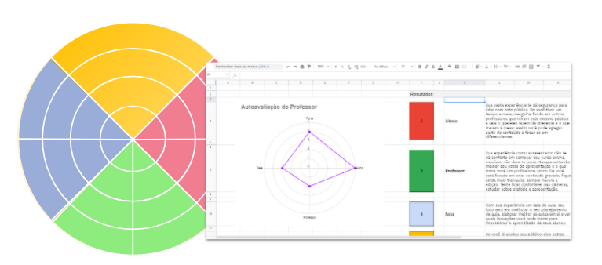
At the end, you'll get a recommendation on what to do and how to improve that specific score.
CLICK HERE TO DOWNLOAD AND TAKE YOUR ASSESSMENT
How to take the first step
If you're interested in becoming an online teacher or education influencer, the first step is to determine which points you need to improve and go after them. With so much content online, it won't be hard to cover the basics so the gaps don't stand out to your learners.
You should define some of your personal goals: what would you like to achieve by becoming an online teacher? Is it extra income? Is it generating qualified leads for your business? Is it positioning in the market? That already changes your direction and the types of content you create a lot. At Escola de Polímatas we have clients in each of these roles, and the way of working ends up being slightly different for each, even though the final product is the content itself.
If you'd like to become an online teacher in a formal education setting, the recommendation will certainly revolve around more formal qualifications, such as undergraduate and graduate degrees in the desired fields.
Ultimately, you can teach however you want and there will almost always be an audience for your style, which is why your personal analysis of your goals is so crucial: what do you want and how much time do you have?
So focus on your target audience, what they already know and think about what they'll be doing after consuming your content. With that in mind, it will be clearer how to build that bridge.
Now you should get organized to produce your content. Organize your references and graphic design skills and start building your program. Then you'll produce, edit and upload your material to the platform you chose. Of course, if your platform (or LMS, short for learning management system) requires programming, you'll have to factor that in as well.
Wrapping up
Some learners learn faster than others, some retain knowledge through visual explanations and others through practice. Everyone has their own way of learning. An online teacher or education influencer has to take all of this into account when planning, producing and delivering their content. Don't take it as a trivial task, since you'll have a lot of responsibility, but it's nothing you can't do with a bit of dedication.
If you have command of your field and a bit of clarity about your goals, you've already taken a good first step.
If you don't have time to develop your content or feel a bit unsure about developing it, count on Escola de Polímatas. Our professionals have a decade of hands-on experience organizing educational content, are teachers themselves and have clients across Brazil (and abroad) to help you in this process.
With the internet, online study has become not only more accessible but also easier and more accepted. Many people see traditional certifications as outdated and slow to respond to the needs of the market, which are increasingly demanding and fast. To meet that need, people have been giving more weight to the word of digital influencers with their unique points of view and practical market experience.
You can become an online teacher and education influencer this year. Count on Escola de Polímatas to reach your goals.
Don't forget to download the self-assessment tool to get greater clarity about your strengths and weaknesses as an online teacher and education influencer.