
AI-personalized learning path for Amazon leaders
Accelerate is a leadership development program for Amazon L4 and L5 managers, built on an internal framework of behavioral competencies (soft skills), organized as a success profile with multiple capabilities and proficiency levels. The challenge was to turn that theoretical model into a practical, continuous and personalized development journey.
Problem:
- The success profile existed but wasn't put into practice day to day
- Learning was concentrated in in-person sessions, with no continuity
- There was no personalization: everyone got the same experience
- There was no real practice for behavioral skills
Solution:
- We built a learning companion app with an AI personalization engine
- Guided onboarding maps the user's current stage, goals and interests
- A learning path is generated automatically, with practical, social and theoretical tasks
- Integration with internal content (Amazon's LMS) and external content The user gets a structured, continuous journey adapted to their real development gaps.
Technologies used:
- Amazon Bedrock (generative AI)
- AWS Lambda + DynamoDB
- Amazon's internal LMS (Learn)
- Custom web front end
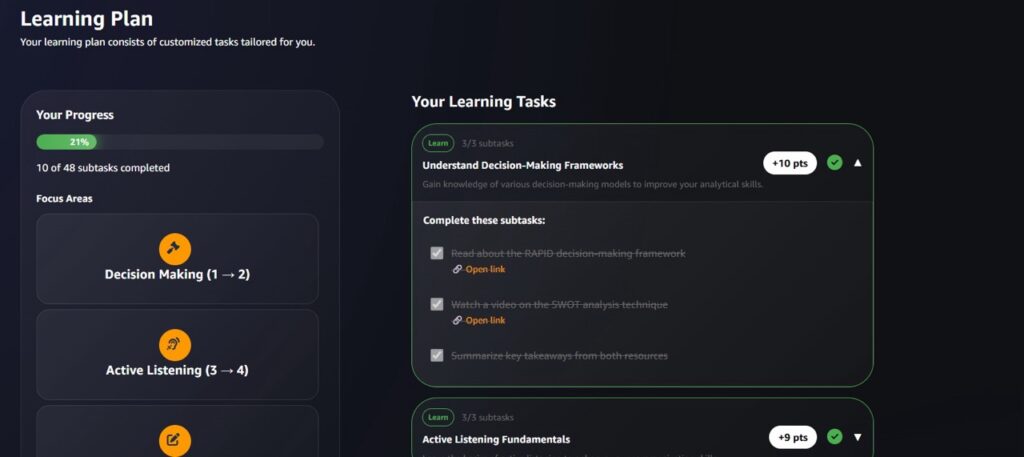 Main screen of the user's learning plan
Learning path architecture and long-term vision
The central point was to turn the success profile, originally a static framework, into a dynamic development system. The architecture has three layers:
- Diagnosis
- Self-assessment across multiple competencies
- Capture of career goals and interests
- Decision engine
- Identification of the main gaps (focus areas)
- Prioritization of development based on individual context
- Learning orchestration
- Generation of a plan with progressive tasks
- Balance between study (theory), practice and social interaction This approach avoided a common problem: simply creating more content. Instead, the focus was on building a system that decides what the user should do. It also lowers operating costs:
- It doesn't depend on continuous manual curation
- It scales to any number of users
- It reuses existing content (LMS + internet)
How do you build a learning path that actually works?
The main trap when building learning paths is treating them as a sequence of content. In this project, the decision was to treat them as a behavior change system. It all starts with onboarding. Onboarding was designed not just to collect data, but to generate enough context for decision-making.
That way, the system avoids a common mistake: defining learning based only on "weaknesses". Instead, it considers gaps + intent + context. The second critical decision was how to turn that diagnosis into action. Instead of generating long, passive paths, the learning path was structured as a sequence of short, executable tasks, built on four principles:
- Action before content Users don't start by reading. They start by doing.
- A mix of formats Each competency is developed from multiple angles: study, practice, social interaction and reflection.
- Application in the real context Whenever possible, tasks happen in the work environment itself (for example, conversations with direct reports).
- Controlled progression The system releases tasks in sequence, avoiding overload and keeping users focused. Another important point was avoiding dependence on manual curation. The AI engine can generate personalized plans without creating new content, just by reorganizing and contextualizing what already exists. Finally, the experience was designed to answer a single question for the user, over and over: "What do I do now?" A learning path works when it removes ambiguity. It doesn't offer options. It offers clear direction.
Learning path features
The AI-generated learning path includes:
- Study tasks
- Content from Amazon's LMS
- Contextualized external materials
- Practice tasks
- Direct application at work
- Simulations and exercises
- Social tasks
- Structured conversations with team and peers
- Practicing feedback and leadership
- Reflection tasks
- Reviewing decisions and behaviors
- Consolidating what was learned Tasks are organized progressively, with:
- Increasing levels of difficulty
- A subtask structure
- A points and progress system During development, we made important adjustments:
- Fewer generic tasks
- More contextualization by role and level (L4 vs. L5)
- A balance between effort and perceived value
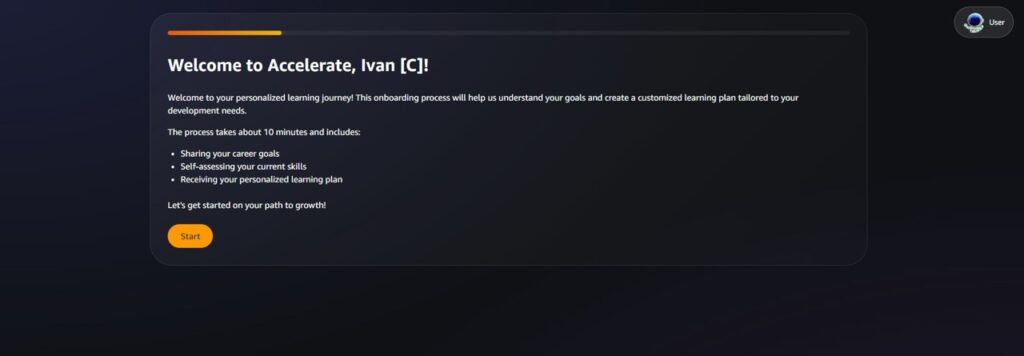 Starting screen of the onboarding process
The final product: a smart learning path customized for each learner
- A static framework turned into an active development system
- More continuity of learning outside the in-person sessions
- Real personalization of the leadership journey
- A scalable AI-based upskilling model Lessons learned:
- The value is not in the content, but in orchestrating what to do
- Soft skills require real practice, not just consumption
- Personalization increases engagement, but it needs a clear structure Next steps:
- Evolve the model with behavioral data (not only self-assessment)
- Refine the recommendation engine
- Connect learning with real performance metrics
This project is the kind of solution I build today at EduBuilders, combining a pedagogical foundation with software.