
Development
Artificial Intelligence
AWS
Artificial Intelligence
Claude
AI decision simulations for Amazon leaders
Accelerate is a leadership development program for Amazon L4 and L5 managers, focused on skills such as communication, decision-making and conflict management. Despite the structured in-person training, little of it carried over into day-to-day work.
Problem:
- Training taught concepts but did not let leaders practice real decisions
- No safe environment to test choices and see their consequences
- Decision-making development was limited to theory and static case studies
- Hard to personalize scenarios to each leader's context
Solution:
- We built an AI-powered Decision Simulations system
- Each simulation is personalized based on the user's profile, context and skill gaps
- The user faces a realistic scenario and makes 3 sequential decisions, each one changing how the situation unfolds
- There are no right answers, only trade-offs and consequences
- At the end, the system generates an evaluation and a score based on the quality of the decisions
Technologies used:
- Amazon Bedrock (LLM for generation and evaluation)
- AWS Lambda (simulation and progression logic)
- DynamoDB (state and history persistence)
- Claude for content generation
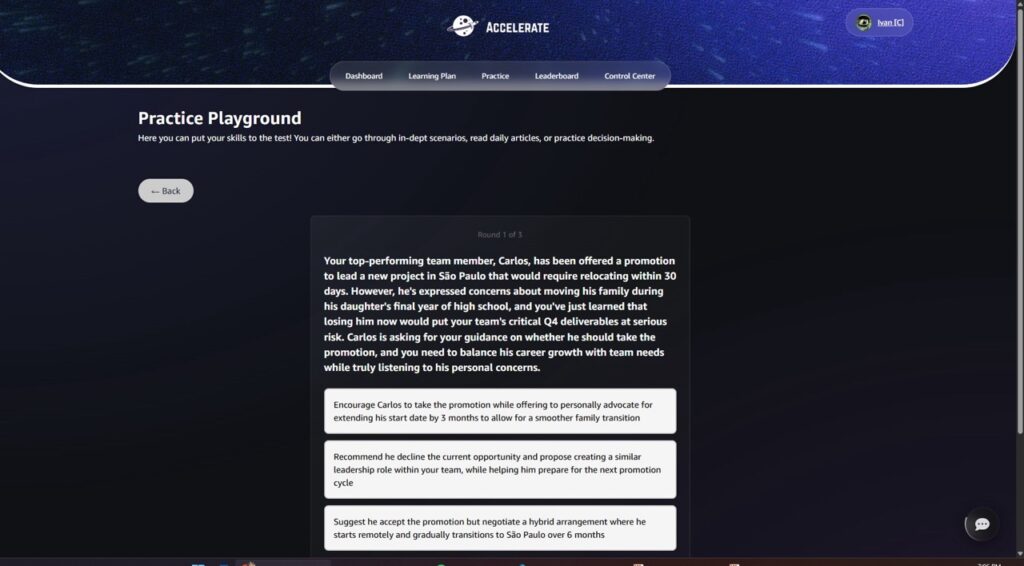 Decision-making screen
How I architected the solution
The main problem was not a lack of content, but a lack of context and realistic practice. We architected the solution as a dynamic simulation system in which each decision changes the state of the scenario. We designed a flow with three layers:
- User context → profile, region, role and competency gaps
- Simulation engine → generation of ambiguous scenarios with multiple paths
- Consequence engine → a story that evolves based on the decisions This architecture reduced the dependence on static content and created a scalable system in which new simulations don't have to be written by hand. We also anticipated a common problem: binary decisions. So we forced the model to generate ambiguous options, all plausible but with different impacts.
Development journey and user experience
The experience was designed to mirror the mental flow of decisions at work:
- The user enters the simulation already holding relevant context
- They receive a realistic situation from their daily work
- They choose among three possible paths
- They see the immediate consequence
- They move on to a new scenario that follows from the previous decision This cycle repeats for three rounds, creating a "decision cascade" effect. We prioritized:
- Low friction (quick decisions, not too much reading)
- Progressive feedback (not only at the end)
- A sense of responsibility for the consequences
Features and product evolution
During development, we refined three key components:
- Dynamic scenario generation It started out generic and evolved to include the user's context (role, region, competencies)
- Ambiguous decision system We tuned the prompts to avoid obvious answers and force real dilemmas
- Final AI evaluation
The system analyzes the three decisions together and produces:
- The impact of the choices
- The quality of the reasoning
- A score (0 to 5 points) We also implemented:
- A daily usage limit (for quality and cost control)
- State persistence between rounds
- Integration with the points system and leaderboard
Results
- Passive content turned into active decision practice
- Higher engagement through short, recurring experiences
- Scenarios can be created at scale without manual design
- More realistic leadership development in ambiguous environments
- Key lesson: effective simulations don't teach answers, they train judgment
- Next step: deepen personalization using the user's decision history
This project is the kind of solution I build today at EduBuilders, combining a pedagogical foundation with software.